A Revelation in Atmosphere
Every artist, when pushed far enough, will have a revelatory moment that becomes foundational to their practice. I’ve often found every single painting I do revealing one “aha” moment upon which a new painting exploring that discovery can flourish. It’s a moment where the painting reveals a truth so obvious you find yourself saying- ok now I understand the entire painting centered on me discovering this- it’s so quietly revolutionary, in hindsight, you can begin to understand why the work had to be born.
My newest painting, “Not Theories, but Revelations”, is an entire canon of what my artist life has taught me thus far. It feels like the most singular, pivotal piece to my entire artistic existence of 36 years around the sun. It is a storm of roses and the universe- of earth-laden pigment with sky-borne awe. What is essential in this piece is the building of atmosphere- I found myself laying a thick stroke of paint in a dark passage, and instantly I felt the painting die in that spot. Everything in that area suffocated instantaneously. In that moment, I realized something that my work has always circled, but something I’ve truly felt guilty for until that moment as it is not a common practice in modern painting.
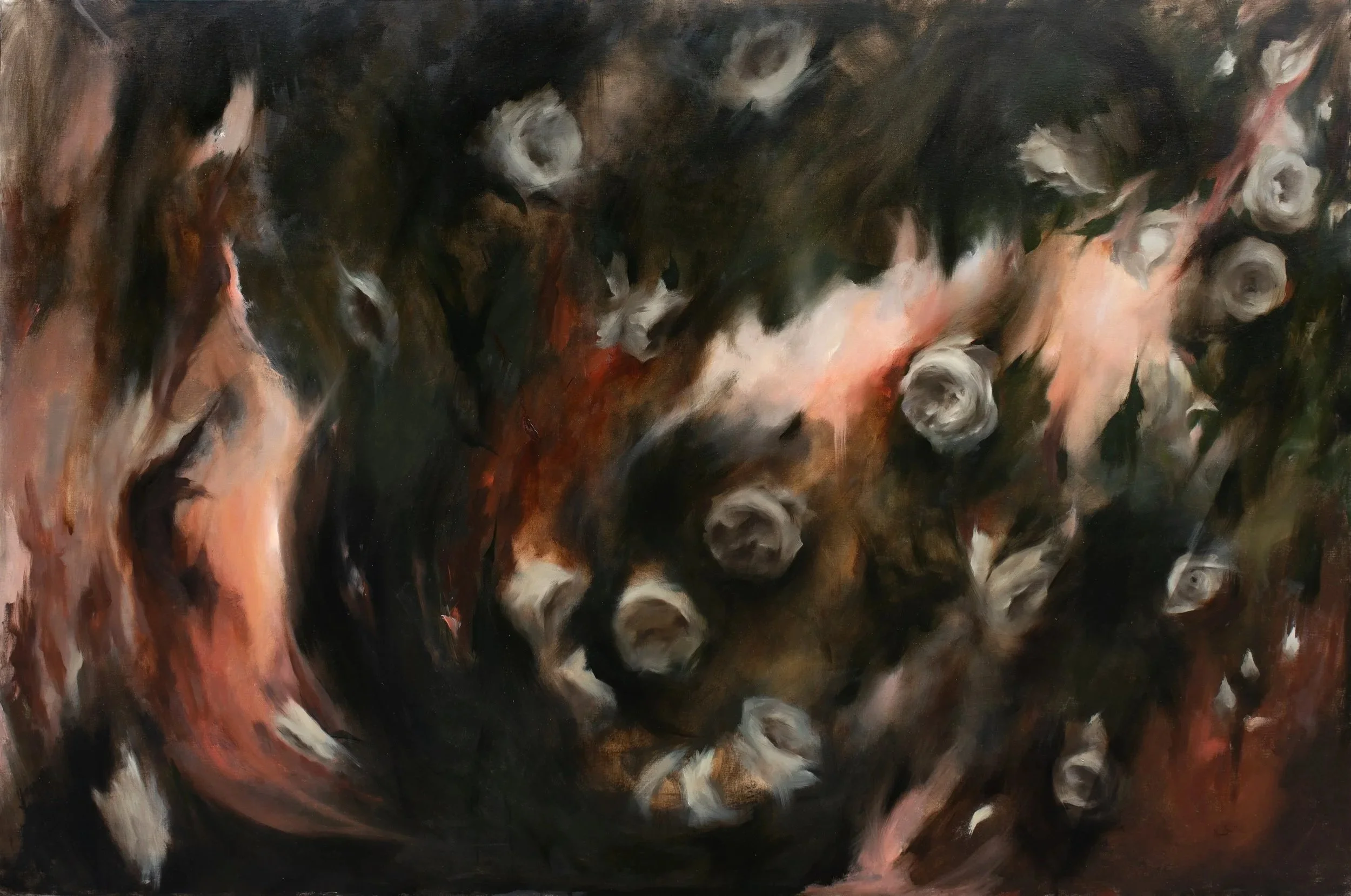
A PIVOT PIECE IN MY WORK- DISCOVERING THE ATMOSPHERE.
An entry from my studio journal in October reads:
“ I’ve been carrying guilt for washing and glazing and only highly selectively placing thick paint in places to achieve supreme atmosphere. Some places I barely touch with a brush- the gentlest, tiniest whisper of medium. It’s almost as if the paint feels like it’s dying when I smear it on thickly- my eye catches the impasto, and it loses hope.”
Thick paint cannot exist everywhere. It is a consecrated act- only the sacred part of the painting gets to live in density.
For years I’ve intuitively worked in veils- passages that are scumbled in or washed of thin color, then left untouched, it was always like that for me because the tension in my mind was vital- this part of the painting cannot be resolved. Even as far back as 2016, I have works I can see myself striving for this effect. Transparent passages must be left to allow the earth to breathe through a work. The history to be visible. Pentimento. Laying thick paint throughout an entire canvas is like slamming a door shut- the mystery completely dies. The eye sinks everywhere all at once. My work lives in disappearance, dissolution, atmosphere, ghosts. RESTRAINT is vital- the paint told me this. Scrubbing with full vigor- rags usually, until I’m sweating. To take back a decision, to reveal the thought beneath. Thick paint takes the story back to the physical realm- but atmospheric work must resist taming- thick paint is essentially an artist trying to tame the earth itself. Atmospheric work dies if an artist is overeager with their materiality.
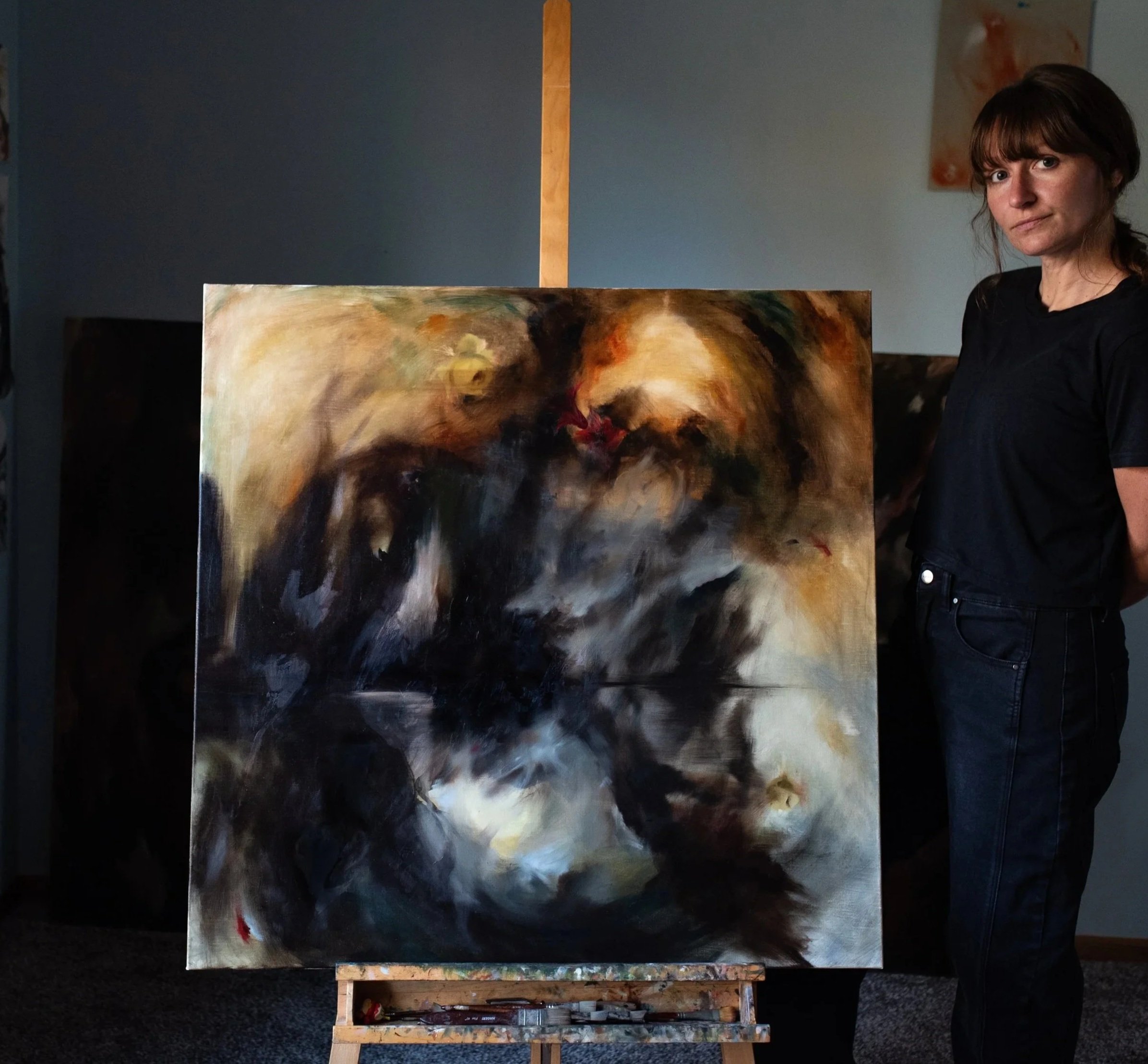
My exploratory work A Descent into the Maelstrom- testing this atmosphere theory. I find this approach in Delacroix’s La Barque de Dante’s upper left passage (see below).
After this revelation, I began to dig into my Romantic lineage again. It’s uncanny how you can view great works of artists you deeply admire, even master copy them, but until you make your own revelation independently, you can’t truly see where your lineage is. it’s almost as if there’s some sort of visual DNA each painter inherits. I realized I had rediscovered for myself a principle held by the Romantics, especially Delacroix, Turner, and Thayer. If you observe the upper left quadrant of La Barque de Dante, Delacroix builds a world out of vapor: raw ground, veils of sienna and green-black (viridian perhaps), violent diagonal energy, smoke over linen. He only allows sacred spaces to have thick paint. The consecrated energy lies in the undone. Thayer also did this often- huge passages left unresolved and atmospheric. The Romantics believed in the holiness of the chosen mark. Even more modern painters, such as Sorolla (see “Strolling along the Seashore” and Schmid (many works)), leave plenty of unresolved atmosphere. The rest must remain potential, becoming atmosphere. You must let nature in to the work, and nature is untamable. It is also potential, it is the unanswered, the very universe we all live in. The shroud over our existence.
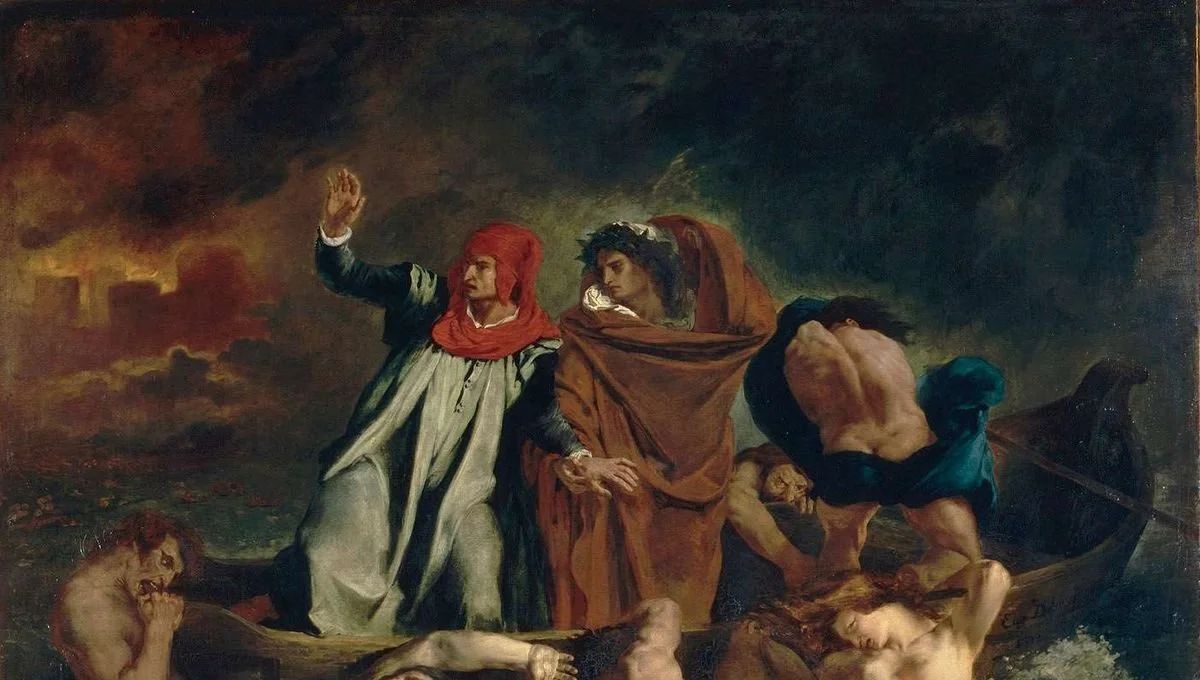
Examine the upper left, areas around the figures head, and far right passages. These are highly atmospheric- thin areas, scumbled and washed in, there is no thick paint and the linen weave is visible. (Delacroix- “La barque de Dante”)
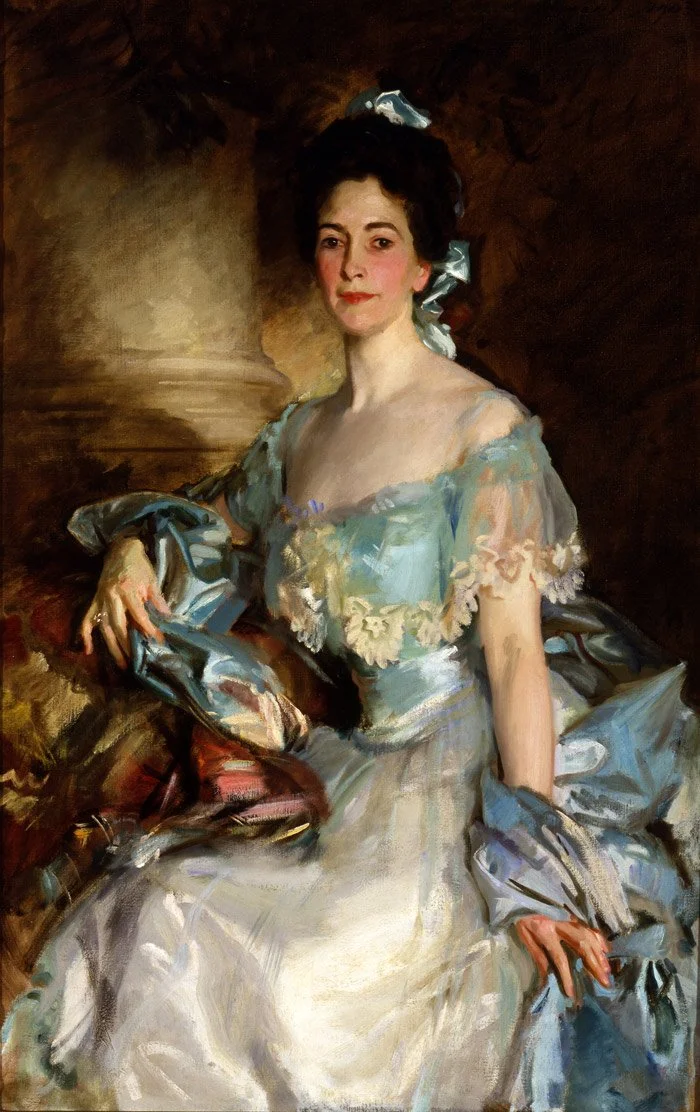
"Mrs. Abbott Lawrence Rotch" , Sargent, Again examine the area surrounding the figure- particularly the upper left- washed in very thin color here and it breathes.
The great (oft forgotten?) equation in painting: Weight (heavy paint)= mortal, Air (washes)= spirit- and you must keep that tension.
Delacroix said (paraphrased): “ A single stroke must justify its existence.”
Sargent said: “ The thicker the paint, the more careful you must be.”
Schmid said: “ One thick stroke should carry the light of ten thin ones.”
Thayer (paraphrased from multiple quotes- manifestos of his from writings and teachings): Nothing exists alone, All is wrapped in air. Paint the air first, and then the thing- softness is nearer to truth than hardness. Light and atmosphere are the soul of the painting.
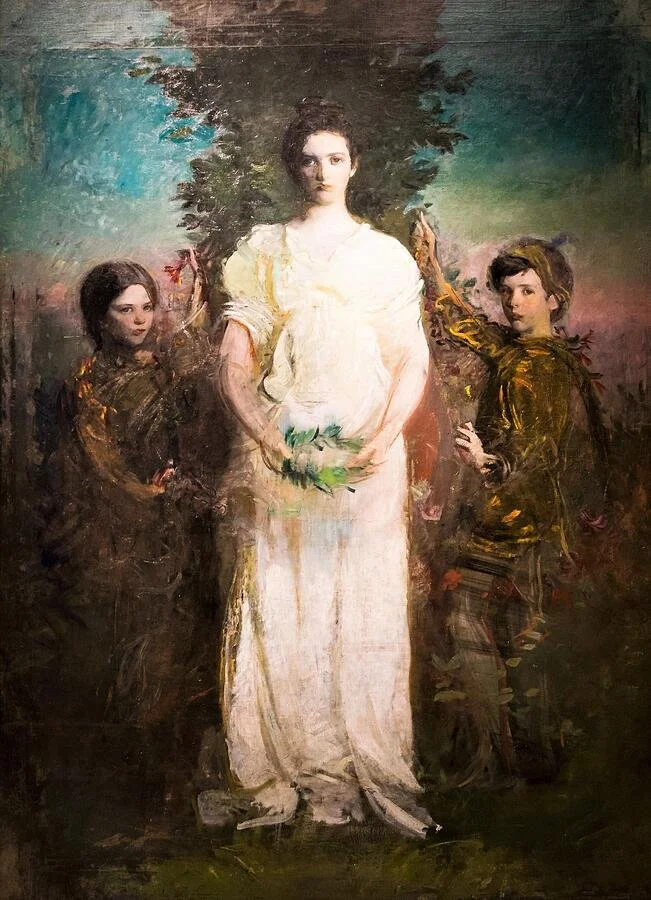
Thayer’s “My Children” exists nearly entirely in atmosphere and thin paint, except in faces and the dress.
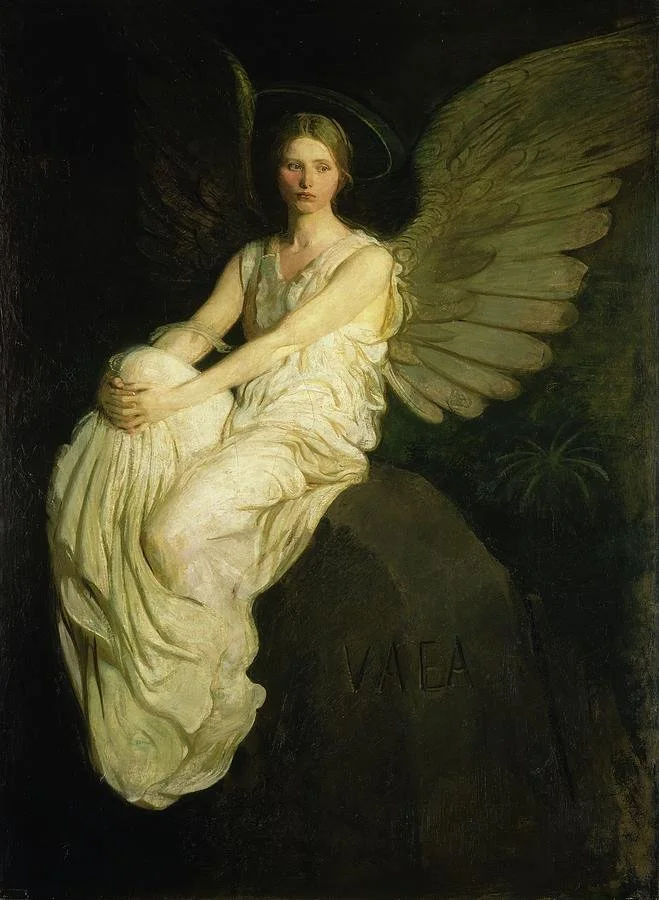
Thayer’s “Stevenson Memorial”- examine the thin passages on either side of the angel, again linen weave is visible.
Thick paint is not the rule. It is the exception- it marks the sacred. Everything else must stay free enough to breathe. It’s why my work feels like to me like the weather, my paintings live inside this veil and I proudly carry this somewhat forgotten tradition. The majority of current academic and contemporary world is driven by thick paint, highly resolved passages throughout entire works, or of late, entire atmosphere scrubs and no thick paint to stop the eye. Let me be very clear, there is no single correct approach. All art succeeds in it’s own way if it is true to it’s own message. I am merely laying out a manifesto after years of independent study and research and I am grateful they paved the way for us.
Thick paint only belongs where the universe touches morality. My guiding light in painting.
Kara Knutson